NEW Articles22 Oct 2026
Film London Production Finance Market 2026
‘You really can feel the energy in the room’ said Samuel Ampah of Alliotts Media at the Film London Production Finance Market (PFM) recently.
Articles
A significant, mandatory change to the Automatic Exchange Of Information (AEOI) rules under the Common Reporting Standard (CRS) is now in effect. Affected Trustees and Directors need to register by 31 December 2025.
An important announcement for Trustees and Directors: A significant, mandatory change to the Automatic Exchange Of Information (AEOI) rules under the Common Reporting Standard (CRS) is now in effect. You must register by 31 December 2025, or face a potential penalty of up to £1,000 for late registration.
Why the New Rules?
The UK Government is updating its regulations to strengthen the implementation of the OECD’s CRS and the US Foreign Account Tax Compliance Act (FATCA).
The core of this legislation places reporting duties on “Financial Institutions” to:
The Challenge: The Broad Definition of a ‘Financial Institution’
The term “Reporting Financial Institution” is much wider than just banks and investment houses. Crucially, it now ensnares many trusts, partnerships, and investment companies that meet the “financial assets test.”
What is the Financial Assets Test?
An entity meets the test if more than 50% of its gross income is derived from activities like investing, reinvesting, or trading in financial assets.
Financial assets are widely defined, but they do not include direct interests in real property (land/buildings) or cash held for operational purposes.
The Management Trap: Managed Investment Entities
Many entities that meet the financial assets test are caught because they are considered “Managed Investment Entities.” This occurs if a Financial Institution (like an investment manager, bank, or even certain corporate trustees) has discretionary authority (directly or through another service provider) to manage, at least in part, the entity’s assets.
Real-World Examples of Entities That Must Register
These common structures are frequently overlooked but are now likely to be classed as Reporting Financial Institutions:
| Structure | Why It’s Caught (The “Human” Reason) |
| Investment Partnerships/LLPs | If the partnership’s primary purpose is investing in stocks, bonds, or other financial assets, and a separate corporate entity (a Financial Institution) manages those investments, it must register. |
| Family Trust with a Corporate Trustee | Even if the corporate trustee doesn’t charge fees directly, if its related law firm or professional service provider charges fees for asset management services, the trust is considered managed by a Financial Institution and must report. |
| Trust with a Mixed Portfolio | A trust holding both properties and a share portfolio managed by an investment firm. If the income from the managed share portfolio is more than 50% of the trust’s total gross income, the trust is now a Reporting Financial Institution. |
| Family Investment Company (FIC) | If the company’s income is primarily generated from its investment portfolio, and a third-party firm handles the investment decisions on a discretionary basis, the FIC must register. (Note: If the directors make all investment decisions themselves, this specific type of discretionary management may not apply.) |
Special Case: Trustee-Documented Trusts (TDTs)
A TDT is a trust where the trustee is already a Reporting Financial Institution and takes on the responsibility to report all necessary account information. While a TDT is technically a Non-Reporting Financial Institution, it is still required to complete the registration process. The registration deadline for TDTs is the later of December 31, 2025, or January 31 following the year they first qualify as a TDT.
How to Complete the Mandatory Registration
To register for AEOI under the CRS with HMRC:
Completing Your Registration: Required Information
To successfully register your entity with HMRC’s Automatic Exchange Of Information (AEOI) service, you will need to gather the following details:
Special Note for Trustee-Documented Trusts (TDTs)
When registering a TDT, the TDT itself must be listed as the Reporting Financial Institution, not the managing trustee. The reporting trustee should, however, be named as the primary contact person.
This flowchart illustrates the definition of Reporting Financial Institutions:

What Happens After Registration? The Annual Report
Once registered, the entity may face an annual reporting requirement. While the specifics of this requirement are complex, the broad principle concerning non-reporting is straightforward:
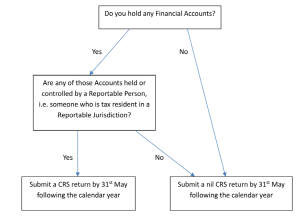
The ‘Nil Return’ Exemption
If your registered entity has no Reportable Accounts, meaning no connection to other jurisdictions (all connected persons are solely UK residents), there is currently no obligation to submit a nil return each year.
Therefore, entities that are exclusively connected to the UK do not need to submit an annual CRS return, though they remain registered Reporting Financial Institutions.
THE AUTHOR

Partner
More & Other Musings
View all related contentNEW Articles22 Oct 2026
‘You really can feel the energy in the room’ said Samuel Ampah of Alliotts Media at the Film London Production Finance Market (PFM) recently.
UPCOMING Webinars & Events2 Nov 2026
Join our expert panel for a detailed look at the Budget announcements and what you need to do next.
UPCOMING Webinars & Events4 Nov 2026
Beyond the headlines: what the Budget really means for you
Articles6 Oct 2026
If your business is approaching its first audit, or you are considering whether a voluntary audit would add value, our specialists auditors can help you.
Articles6 Oct 2026
It's important for employers to be aware of the changes and to make sure that their policies and procedures are easy to put in practice.